Electrochemistry is the branch of physical chemistry that studies the relationship between electricity, as a measurable and quantitative phenomenon, and identifiable chemical change, with either electricity considered an outcome of a particular chemical change or vice versa. These reactions involve electric charges moving between electrodes and an electrolyte (or ionic species in a solution). Thus electrochemistry deals with the interaction between electrical energy and chemical change.
When a chemical reaction is caused by an externally supplied current, as in electrolysis, or if an electric current is produced by a spontaneous chemical reaction as in a battery, it is called an electrochemical reaction. Chemical reactions where electrons are transferred directly between molecules and/or atoms are called oxidation-reduction or (redox) reactions. In general, electrochemistry describes the overall reactions when individual redox reactions are separate but connected by an external electric circuit and an intervening electrolyte.
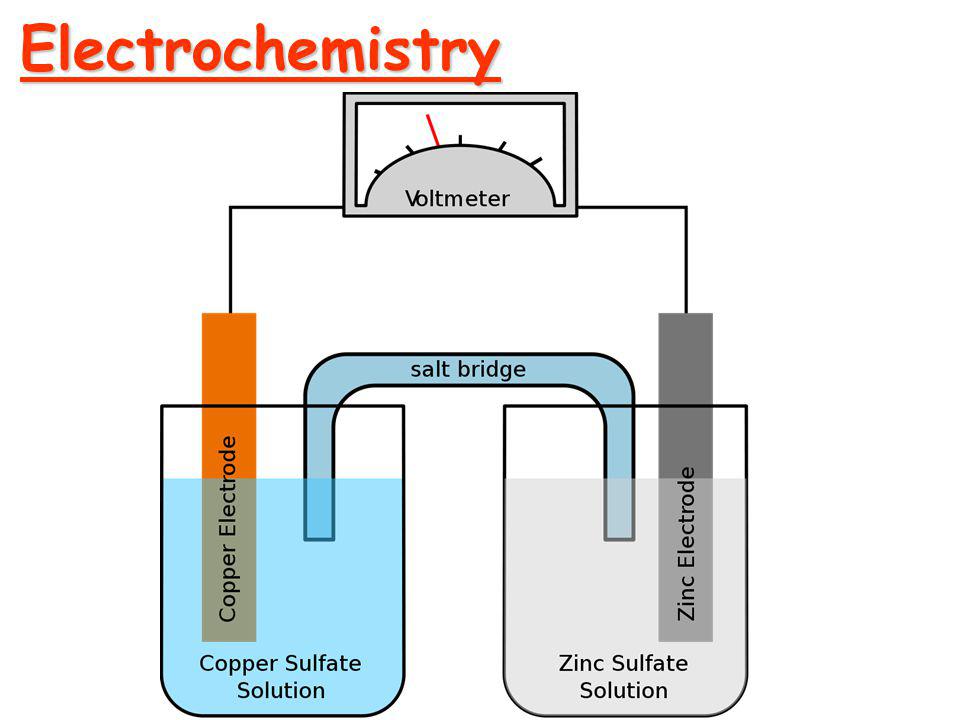
Galvanic cell
An electrochemical cell is a device that produces an electric current from energy released by a spontaneous redox reaction. This kind of cell includes the Galvanic cell or Voltaic cell, named after Luigi Galvani and Alessandro Volta, both scientists who conducted several experiments on chemical reactions and electric current during the late 18th century.
Electrochemical cells have two conductive electrodes (the anode and the cathode). The anode is defined as the electrode where oxidation occurs and the cathode is the electrode where the reduction takes place. Electrodes can be made from any sufficiently conductive materials, such as metals, semiconductors, graphite, and even conductive polymers. In between these electrodes is the electrolyte, which contains ions that can freely move.
The galvanic cell uses two different metal electrodes, each in an electrolyte where the positively charged ions are the oxidized form of the electrode metal. One electrode will undergo oxidation (the anode) and the other will undergo reduction (the cathode). The metal of the anode will oxidize, going from an oxidation state of 0 (in the solid form) to a positive oxidation state and become an ion. At the cathode, the metal ion in solution will accept one or more electrons from the cathode and the ion's oxidation state is reduced to 0. This forms a solid metal that electrodeposits on the cathode. The two electrodes must be electrically connected to each other, allowing for a flow of electrons that leave the metal of the anode and flow through this connection to the ions at the surface of the cathode. This flow of electrons is an electric current that can be used to do work, such as turn a motor or power a light.
A galvanic cell whose electrodes are zinc and copper submerged in zinc sulfate and copper sulfate, respectively, is known as a Daniell cell.
Half reactions for a Daniell cell are these:
- Zinc electrode (anode): Zn(s) → Zn2+(aq) + 2 e−
- Copper electrode (cathode): Cu2+(aq) + 2 e− → Cu(s)
To provide a complete electric circuit, there must also be an ionic conduction path between the anode and cathode electrolytes in addition to the electron conduction path. The simplest ionic conduction path is to provide a liquid junction. To avoid mixing between the two electrolytes, the liquid junction can be provided through a porous plug that allows ion flow while reducing electrolyte mixing. To further minimize mixing of the electrolytes, a salt bridge can be used which consists of an electrolyte saturated gel in an inverted U-tube. As the negatively charged electrons flow in one direction around this circuit, the positively charged metal ions flow in the opposite direction in the electrolyte.In this example, the anode is the zinc metal which is oxidized (loses electrons) to form zinc ions in solution, and copper ions accept electrons from the copper metal electrode and the ions deposit at the copper cathode as an electrodeposit. This cell forms a simple battery as it will spontaneously generate a flow of electric current from the anode to the cathode through the external connection. This reaction can be driven in reverse by applying a voltage, resulting in the deposition of zinc metal at the anode and formation of copper ions at the cathode.
A voltmeter is capable of measuring the change of electrical potential between the anode and the cathode.
Electrochemical cell voltage is also referred to as electromotive force or emf.
A cell diagram can be used to trace the path of the electrons in the electrochemical cell. For example, here is a cell diagram of a Daniell cell:
- Zn(s) | Zn2+ (1M) || Cu2+ (1M) | Cu(s)
First, the reduced form of the metal to be oxidized at the anode (Zn) is written. This is separated from its oxidized form by a vertical line, which represents the limit between the phases (oxidation changes). The double vertical lines represent the saline bridge on the cell. Finally, the oxidized form of the metal to be reduced at the cathode, is written, separated from its reduced form by the vertical line. The electrolyte concentration is given as it is an important variable in determining the cell potential.
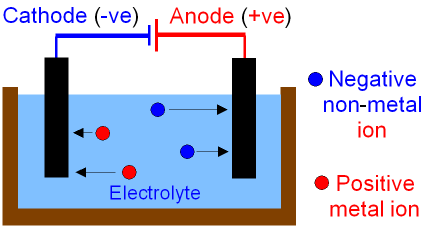
Electrolysis cell
Tipsssss!
KNAPE : Katod, Negatif, Anod, Positive, Electrolisis
KPANG : Katod, Positive, Anod, Negatif, Galvanic cell
References
- Richard P. Olenick, Tom M. Apostol, David L. Goodstein Beyond the mechanical universe: from electricity to modern physics, Cambridge University Press (1986) ISBN 0-521-30430-X, p. 160
- R. Hellborg Electrostatic accelerators: fundamentals and applications (2005) ISBN 3540239839 p. 52
- Steven Weinberg The discovery of subatomic particlesCambridge University Press (2003) ISBN 0-521-82351-X, p. 15
- J. A. M. Bleeker, Johannes Geiss, M. Huber The century of space science, Volume 1, Springer (2001) ISBN 0-7923-7196-8 p. 227
- John Robert Norris, Douglas W. Ribbons (1972) Methods in microbiology, Volume 6, Academic Press. ISBN 0-12-521546-0 p. 248
- Frederick Collier Bakewell Electric science; its history, phenomena, and applications, Ingram, Cooke (1853) pp. 27–31
Comments
Post a Comment